



The nursing dissertation represents one of the most significant academic milestones in your journey toward becoming a registered nurse in the UK. As we move through 2026, with ongoing NHS pressures, evolving healthcare policies, advancing technology, and a continued focus on patient-centred care, your dissertation offers a unique opportunity to explore issues that matter both academically and clinically.Nursing Dissertation
This comprehensive guide provides everything you need: trending dissertation topics tailored for UK students, step-by-step writing advice, structural requirements, research strategies, and practical support options. Whether you’re studying adult nursing, mental health, community care, or child health, you’ll find actionable insights to produce a high-quality, original dissertation that meets university standards and contributes meaningfully to nursing practice.Nursing Dissertation

Why Your Nursing Dissertation Matters in 2026
The UK healthcare landscape continues to transform rapidly. Post-pandemic recovery, workforce shortages, digital innovation, and an ageing population shape nursing research priorities. A strong dissertation demonstrates your ability to apply evidence-based practice, critical thinking, and research skills — qualities highly valued by the Nursing and Midwifery Council (NMC) and NHS employers.Nursing Dissertation
Universities across the UK (from Russell Group institutions to modern universities) expect dissertations that align with NHS priorities such as patient safety, health inequalities, mental health integration, and sustainable care models. Choosing a relevant topic not only boosts your grades but can also open doors for publications, conference presentations, or career specialisations.Nursing Dissertation
How to Choose the Right Nursing Dissertation Topic
Selecting a topic is the foundation of your success. A good topic should be:
- Relevant to UK healthcare: Align with NHS Long Term Plan, NMC standards, or current policy.
- Feasible: Manageable within your timeframe and resources (especially for primary data collection).
- Original yet supported: Builds on existing literature with a fresh angle.
- Personally interesting: Sustains your motivation through months of work.
Key considerations for 2026:
- Impact of AI and telehealth on nursing practice
- Mental health support for nurses and patients
- Health equity and underserved communities
- Climate change and sustainable healthcare
- Post-COVID long-term effects
- Workforce wellbeing and retention
Start by reviewing recent NHS reports, NICE guidelines, and your module handbook. Discuss ideas with your supervisor early.Nursing Dissertation
Trending Nursing Dissertation Topics for UK Students 2026
Here are carefully curated topics across major specialisations. These draw from current trends and are designed to be adaptable for literature reviews, qualitative studies, or mixed-methods research.
Adult Nursing Dissertation Topics
Adult nursing remains the largest field, with ample opportunities for impactful research.
- The impact of nurse staffing ratios on patient safety outcomes in UK acute care hospitals
- Evaluating the effectiveness of early warning scoring systems in preventing clinical deterioration
- Managing chronic wounds in community settings: Barriers faced by district nurses in England
- Patient experiences of living with long COVID: A nursing perspective on holistic care
- The role of advanced nurse practitioners in reducing emergency department waiting times
- Exploring cultural competence in caring for diverse ethnic populations in NHS hospitals
- Impact of shift work patterns on adult nurse wellbeing and patient care quality in 2026
Mental Health Nursing Dissertation Topics
Mental health continues as a national priority with integrated care models expanding.
- Effectiveness of nurse-led cognitive behavioural interventions for anxiety in primary care
- Reducing stigma around mental health through community nursing education programmes
- The experiences of mental health nurses supporting patients with dual diagnosis (substance misuse and mental illness)
- Impact of tele-mental health services on access for rural and remote UK populations
- Nurse burnout and resilience strategies following sustained NHS pressures
- Supporting families and carers of individuals with dementia in community settings
- Role of school nurses in early identification of adolescent mental health issues
Community and Public Health Nursing Topics
Community nursing gains importance with the shift toward integrated care systems.
- The contribution of community nurses to reducing hospital readmissions among elderly patients
- Health promotion strategies for obesity management in deprived UK communities
- Evaluating nurse-led vaccination programmes and public confidence post-pandemic
- Supporting elderly patients with multimorbidity through integrated community care
- The role of district nurses in end-of-life care at home versus hospice settings
Child Health and Paediatric Nursing
- Pain management techniques for paediatric patients in emergency departments
- Supporting families of children with complex needs in the community
- Impact of social media on adolescent mental health: Nursing intervention strategies
- Neonatal nursing care for premature infants in UK neonatal units
Leadership, Education & Technology in Nursing
- The influence of nursing leadership on team morale and retention in NHS trusts
- Use of artificial intelligence in clinical decision support for nurses
- Effectiveness of simulation-based training for nursing students in preparing for real-world practice
- Ethical considerations of digital health records in nursing documentation
These topics can be narrowed or broadened depending on your programme level (BSc, MSc, or DNP). Many lend themselves well to systematic reviews, which are popular for time-constrained students.

Understanding the Standard Nursing Dissertation Structure
Most UK universities follow a similar structure, though always confirm with your specific guidelines.
1. Introduction
Set the context, state your research question or aim, outline objectives, and explain the study’s significance. Include a brief overview of UK healthcare relevance.
2. Literature Review
Critically analyse existing research. Use databases like CINAHL, MEDLINE, PubMed, and British Nursing Index. Demonstrate your ability to synthesise evidence and identify gaps your study addresses.
3. Methodology
Describe your research design (qualitative, quantitative, or mixed), data collection methods, sampling, ethical considerations (especially important with NHS REC approval if needed), and data analysis approach. Justify your choices rigorously.
4. Results/Findings
Present data objectively using tables, charts, and thematic analysis where appropriate. Avoid interpretation here.
5. Discussion
Interpret your findings in relation to existing literature. Discuss implications for nursing practice, limitations, and recommendations.
6. Conclusion and Recommendations
Summarise key points and suggest areas for future research or policy changes.
Additional sections typically include Abstract, References (Harvard or APA as per university), Appendices, and sometimes a Reflective Account.
Step-by-Step Process to Write a High-Scoring Nursing Dissertation
Step 1: Planning and Proposal Develop a clear proposal including background, rationale, aims, and preliminary literature. Get supervisor approval before proceeding.
Step 2: Ethical Approval If involving human participants, apply through your university’s ethics committee or NHS processes. This can take time, so plan ahead.
Step 3: In-Depth Research Allocate dedicated time for literature searching. Use Boolean operators and keep meticulous records for your reference management tool (EndNote, Zotero, or Mendeley).
Step 4: Writing Phase Write regularly rather than in large blocks. Many students find starting with the literature review or methodology easier. Aim for clear, academic yet accessible language.
Step 5: Critical Analysis UK markers reward critical evaluation over mere description. Always ask “So what?” and link back to nursing practice.
Step 6: Editing and Proofreading Leave time for multiple revisions. Check for coherence, academic tone, grammar, and adherence to word count. Professional proofreading can make a significant difference.
Step 7: Formatting and Submission Follow university template precisely for margins, font, line spacing, and referencing.
Common Challenges UK Nursing Students Face & How to Overcome Them
- Time Management: Balancing clinical placements with dissertation work is tough. Create a realistic Gantt chart and break tasks into weekly goals.
- Access to Participants: NHS research governance can be complex. Consider secondary data analysis or literature-based dissertations if primary research proves difficult.
- Writer’s Block: Start with free writing or discuss ideas with peers.
- Statistical Analysis: Use SPSS, NVivo, or seek university support services if quantitative methods feel overwhelming.
- Burnout: Prioritise self-care. The same compassion you show patients, extend to yourself.
MBA Dissertation Topics That Impress UK Universities: A Complete Guide for 2026 Students
How Professional Dissertation Help Can Support You
While writing your own dissertation builds essential skills, many students benefit from expert guidance, especially with tight deadlines or complex topics. Professional services can assist with topic refinement, literature review support, methodology advice, editing, or full dissertation writing while maintaining academic integrity.
At UK Dissertation Writers, our nursing specialists understand NMC standards, NHS contexts, and university expectations. We help ensure your work is original, well-researched, and tailored to 2026 healthcare realities. Whether you need help with a specific chapter or comprehensive support, ethical assistance is available to help you submit with confidence.
Final Tips for Success in 2026
- Stay updated with nursing journals like British Journal of Nursing, Journal of Advanced Nursing, and Nursing Times.
- Attend research seminars and RCN events for inspiration.
- Build a strong relationship with your supervisor — regular feedback is invaluable.
- Back every claim with high-quality evidence.
- Remember the bigger picture: Your dissertation can influence future practice and patient outcomes.
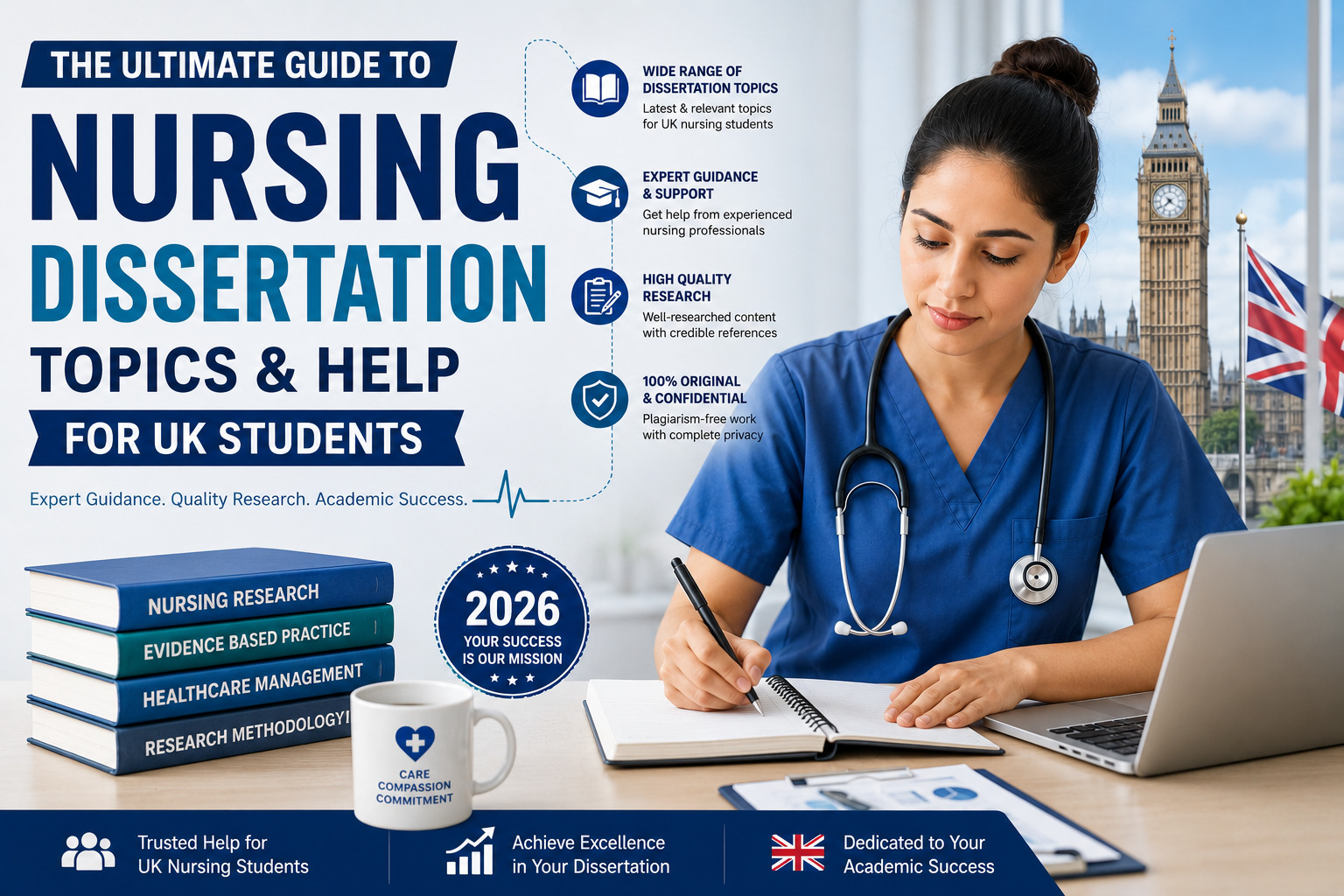
Writing a nursing dissertation is demanding but deeply rewarding. It consolidates your learning and prepares you for leadership roles in a dynamic profession. By choosing a relevant topic, following a structured approach, and seeking support when needed, you can produce work you’re proud of and that contributes to the nursing profession in the UK.
Start early, stay organised, and believe in your ability to make a difference through research. The patients and communities you will serve deserve nurses who are not only clinically competent but also critically reflective and evidence-informed.
If you’re feeling overwhelmed or need personalised guidance on your nursing dissertation, our team at UK Dissertation Writers is here to help you every step of the way. From topic selection to final submission, we support UK nursing students in achieving their academic goals while maintaining the highest standards of integrity.Nursing Dissertation

